
Decorative window film provides privacy while maintaining natural light by utilizing advanced light-scattering micro-structures or translucent matte finishes. These specialized layers break up direct visual sightlines, blurring objects and individuals behind the glass, while simultaneously letting up to 80% or more of ambient, non-directional visible light pass smoothly through the material into the room.
The Physics of Light Transmission vs. Diffusion
When managing a commercial property or corporate environment, architectural design decisions heavily impact workspace utility. Many designers default to clear glass to keep spaces bright and open, but they quickly run into problems with confidentiality and interior exposure. Understanding how to solve this dilemma requires looking at the physical difference between blocking light and scattering it.
Understanding Specular vs. Diffuse Transmission
- Specular Transmission (Clear Glass): Light rays travel in perfectly parallel lines straight through the glass pane. This allows eye-level vision to remain completely uninterrupted, creating a sharp, high-contrast, and undistorted image of what is on the other side.
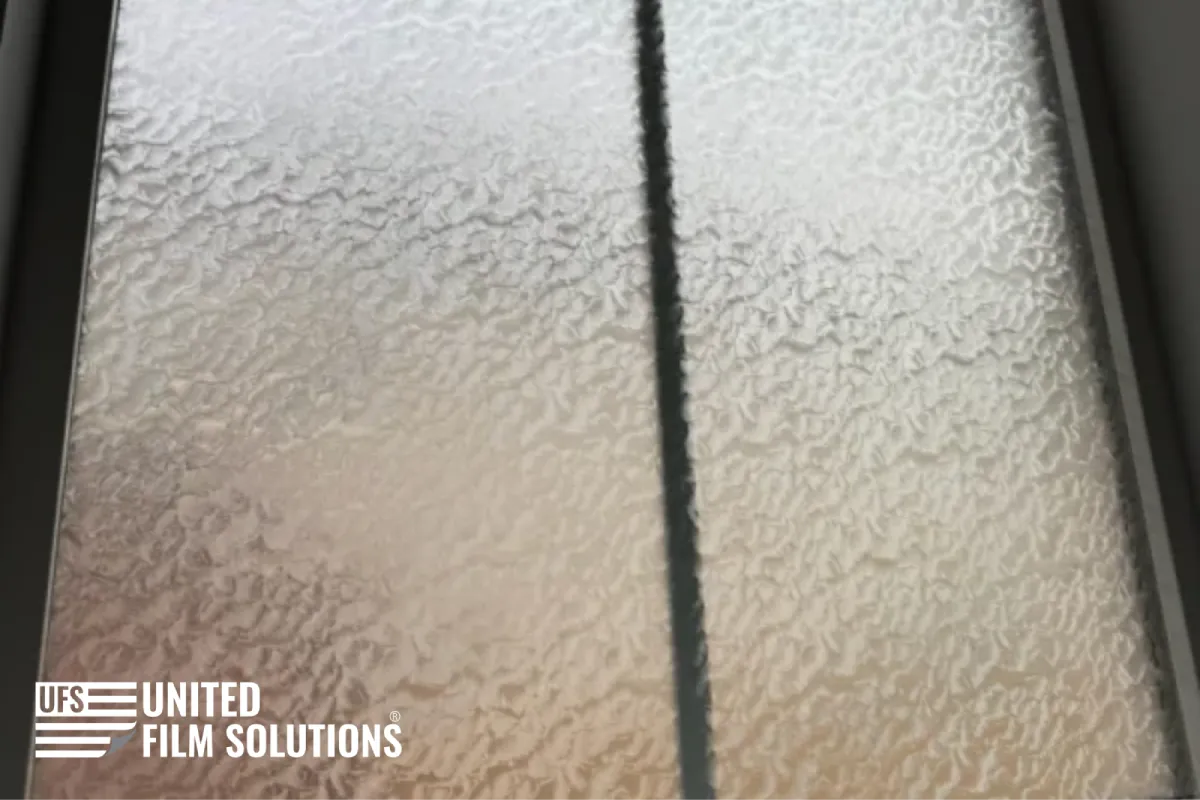
- Diffuse Transmission (Decorative Film): The engineered surface treatment or internal matrix of a high-end film refracts, bends, and scatters incoming light rays in millions of opposing directions. By dispersing the direct path of the photons, the coherent visual image is dissolved, while nearly all of the actual luminous energy transfers cleanly into the room.
Performance Comparison: Decorative Film vs. Traditional Privacy Methods
Evaluating privacy options shouldn’t come down to a guessing game. During a recent workspace evaluation for a professional services firm in Greenville, precision light meters revealed that standard commercial building blinds cut out up to 85% of usable ambient daylight when closed.
To help property managers and general contractors make informed infrastructure choices, the table below breaks down how high-performance film upgrades stack up against traditional privacy methods.
| Privacy Method | Light Transmission Level | Visual Privacy Style | Modification Type | Maintenance Requirement |
| Clear Glass | Very High (88% – 92%) | None (Total Visibility) | Baseline | Standard Cleaning |
| Decorative/Frosted Film | High (70% – 85%) | Blurred / Obscured Shapes | Surface Treatment | Standard Cleaning |
| Acid-Etched Glass | High (75% – 85%) | Permanent Frost | Structural Change | Specialized Cleaning |
| Blinds / Drapes | Low to Medium (0% – 50%) | Full Block (When Closed) | Hardware Install | Heavy Dusting / Laundering |
Key Optical Specifications Defined
Selecting the right solution for a modern office environment requires looking past cosmetic appearances and focusing on verified performance metrics:
- Visible Light Transmission (VLT): The exact percentage of electromagnetic radiation within the visible spectrum that passes completely through a treated glazing system, dictating actual interior daylighting levels.
- Privacy Rating / Opacity Level: A standard tiering scale determining the distance at which an object or person behind the glass loses its defined outline and becomes an unrecognizable blur.
- Clarity Index: The measurement of high-contrast detail preservation through an optical medium, which is deliberately minimized by diffuse texturing to protect interior privacy.
- UV Rejection Rate: The percentage of destructive ultraviolet wavelengths blocked by the film’s embedded chemical construction, independently protecting interior furnishings and skin health regardless of visual frost design.
Debunking the Myth: Privacy Requires Sacrificing Your Daylight
A persistent misunderstanding among building managers and space planners is that shielding a room from view requires cutting down on light entry. This assumption treats window privacy like a simple blackout shade, implying that if you want to stop people from looking into an executive suite or a medical clinic, you have to turn the room into a dim, artificial-light-dependent box.
The material science reality is that light blocking and light scattering are completely different physical processes. Dark solar tints or heavy fabric drapes achieve privacy via absorption or total reflection, stopping light from entering the room entirely.
Decorative privacy film handles light completely differently. It acts as an active optical diffuse barrier. It rearranges the incoming photons without destroying them, meaning you can completely obscure a high-security meeting space from the corridor while keeping the room flooded with soft, glare-free daylight. This maintains worker productivity, prevents eye strain, and lowers building energy consumption all at once.
Applying Our Elite Solutions to Solve This
At United Film Solutions, we approach architectural window film as a long-term investment, not just a surface upgrade. Our team provides expert guidance and science-based recommendations to help you choose the right solution for your building, ensuring lasting performance without unnecessary rework.
Our high-performance decorative films provide privacy and style while preserving natural light. Whether you need custom patterns or frosted finishes for offices and storefronts, our premium decorative film in Spartanburg, SC, solutions create a clean, professional appearance that complements your brand and workspace.
For conference rooms, glass partitions, and retail spaces, we carefully plan each installation to improve privacy without replacing existing glass. Our Spartanburg, SC decorative film options deliver the elegant look of etched or frosted glass at a fraction of the cost, making them a practical and cost-effective solution.
Every project begins with a detailed evaluation of your lighting conditions, privacy needs, and design goals. We recommend the ideal film based on your space, providing a transparent, no-pressure consultation so you understand exactly what to expect before installation.
Backed by commercial-grade materials and skilled craftsmanship, we deliver precise installations with clean finishes that resist bubbling, peeling, and premature wear. The result is a durable, professional privacy solution that enhances your space and continues to perform for years to come.
Maximizing the Value of Commercial Spaces
Integrating high-performance film technology is an essential operational strategy for modern building managers. For instance, during a specialized glass evaluation for an office complex in Spartanburg, our targeted approach helped the facility manager resolve a massive afternoon temperature imbalance that standard tinted glass couldn’t fix. By opting for a professional Spartanburg decorative film or solar control layout, you address the root cause of solar heat gain rather than forcing your HVAC systems to work overtime.
This methodical application preserves more than just energy; it safeguards your long-term interior investments. High UV radiation quickly degrades high-end furnishings, fades commercial merchandise displays, and cracks leather seating surfaces.
Applying premium decorative film in Spartanburg packages or technical solar films blocks these destructive radiation bands entirely. This proactive approach ensures your commercial assets maintain their premium look and stay fully protected for years to come.
Upgrade Your Corporate Architecture with United Film Solutions
Window film isn’t just tint, it’s an intentional performance upgrade for your commercial asset. Relying on makeshift blinds or expensive glass replacements creates unnecessary overhead and disrupts daily business operations. Protecting your team’s privacy while maximizing valuable southern daylight requires a specialized partner who understands the exact material science of architectural films.
At United Film Solutions, I truly stand behind every answer I’ve provided. We look at every commercial pane as an opportunity to improve comfort, appearance, and workspace performance without the common sales pressure.
Take the guesswork out of your space planning. Contact us today to request a clear, data-driven quote for your commercial property.
People Also Ask
Does frosted decorative film look completely opaque from the outside at night when interior lights are on?
No, it does not become completely opaque or turn transparent. At night, if the interior room is brightly lit and the exterior corridor is dark, people outside will see bright, glowing shapes and soft, blurred silhouettes, but they still cannot resolve fine details, facial features, or confidential screen content.
Can decorative privacy film be easily removed if the office layout needs or branding requirements change?
Yes. Unlike permanent acid-etching or physical sandblasting, commercial-grade decorative films can be cleanly uninstalled by professionals without scratching or compromising the underlying structural glass sheet, which is an ideal feature for leased corporate real estate.
How do you clean windows that have decorative privacy film installed on them?
Once fully cured and bonded, glass surfaces treated with professional privacy film can be maintained normally. They should be cleaned using soft microfiber cloths and standard, non-abrasive, ammonia-free soapy water solutions to protect the outer surface texture.